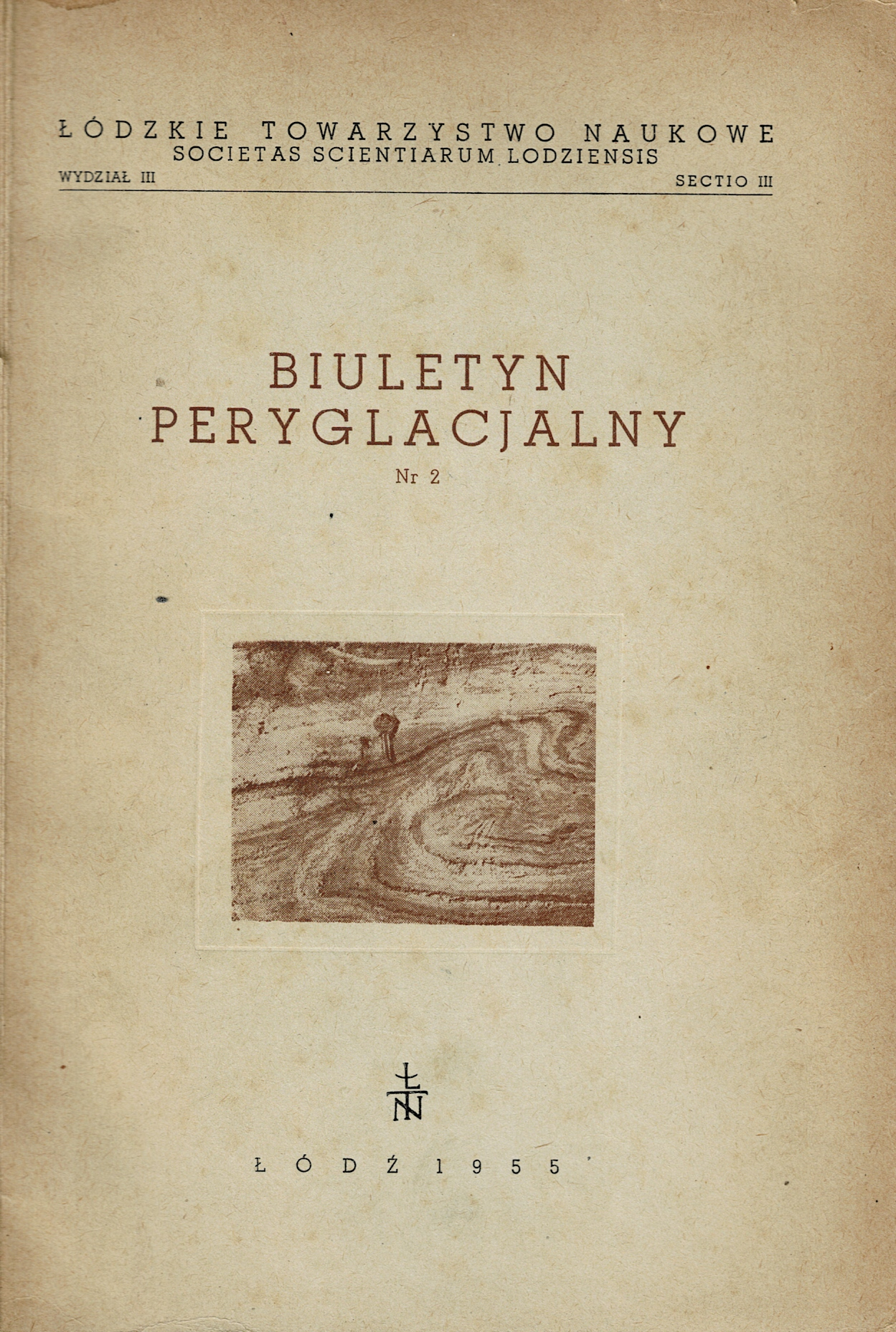
Congeliflual structures in the Łódź region
DOI:
https://doi.org/10.26485/BP/1955/2/11Keywords:
periglacial structures, permafrost active layer, mass movementAbstract
Some interesting congeliflual structures were observed near the village of Wilanów in the region of Łódź. Three types of structures were distinguished: sand packets, spindle-forms and plications. The origin of these structures is attributable to processes occurring in the active layer of frozen ground.
The interrelation of the structures and the arrangement of the material contained within, prompt the conclusion that the inclination of the present-day slope roughly parallels the fossil surface and confirms the decrease of mass in the upper portions and its accumulation in the lower part of the slope.
References
1. Andersson J. G., 1906 - Solifluction, a component of subaerial denudation. Jour. Geol., vol. 14.
2. Bac St., 1950 - Ruchy warstw gleby wskutek zamarzania i tajania. Wiad. Sł. Hydr.-Met. 3. Beskow G., 1930 - Erdfliessen und Strukturboden der Hochgebirge im Licht der Frosthebung. Geol. Foren. i Stockholm Forhandl., Bd. 52.
4. Budel J. 1944 - Die morphologischen Wirkungen des Eiszeitklimas im gletscherfreien Gebiet. Geol. Rundschau, Bd. 34.
5. Dylik J., 1952 - Peryglacjalne struktury w plejstocenie środkowej Polski (summary: Periglacial structures in the Pleistocene deposits of Middle Poland). Biul. Państw. Inst. Geol., 66.
6. Dylik J., 1952 - Pierwsza wiadomość o utworach pokrywowych w środkowej Polsce (summary: First report on covering deposits in Middle Poland). Biul. Państw. Inst. Geol., 68.
7. Dylik J., 1953 - O peryglacjalnym charakterze rzeźby środkowej Polski (resume: Du caractere periglaciaire de la Pologne centrale). Acta Geogr. Vniv. Lodz., nr 4, Łódzkie Tow. Naukowe, Łódź.
8. Grigoriew A A., 1946 - Subarktika (The Sub Arctica). Akad. Nauk SSSR.
9. Hogbom B., 1914 - Uber die geologische Bedeutung des Frostes. Bull. Geol. Instit. Upsala, vol. 12.
10. Jahn A., 1951 - Zjawiska krioturbacyjne współczesnej i plejstoceńskiej strefy peryglacjalnej (summary: Cryoturbate phenomena of the contemporary and of the Pleistocene periglacial zone). Acta Geol. Polonica, vol. 2.
11. Klimaszewski M., 1948 -Polskie Karpaty Zachodnie w okresie dyluwialnym (Polish West Carpathian during Ice age). Prace Wrocl. Tow. Nauk., Ser. B, nr 7.
12. Klimaszewski M., Szafer W., Szafran Br., Urbański J., 1950 - Flora dryasowa w Krościenku nad Dunajcem (summary: The dryas flora of Krościenko on the river Dunajec). Biul. Państw. Inst. Geol., 24.
13. Paterson T. T., 1940 - The effects of frost action and solifluction around Baffin Bay and in the Cambridge district. Quart. Jour. Geol. Soc. London, vol. 96.
14. Penck W., 1924 - Morphologische Analyse. Stuttgart.
15. Sawicki L., 1952 -Warunki klimatyczne akumulacji lessu młodszego w świetle wyników badań stratygraficznych stanowiska paleolitycznego na Zwierzyńcu w Krakowie (resume: Les conditions climatiques de la periode de l'accumulation du loess superieur aux environs de Cracovie). Biul. Państw. Inst. Geol., 66.
16. Troll C., 1947 - Die Formen der Solifluktion und die periglaziale Bodenabtragung. Erdkunde, Bd. 1.