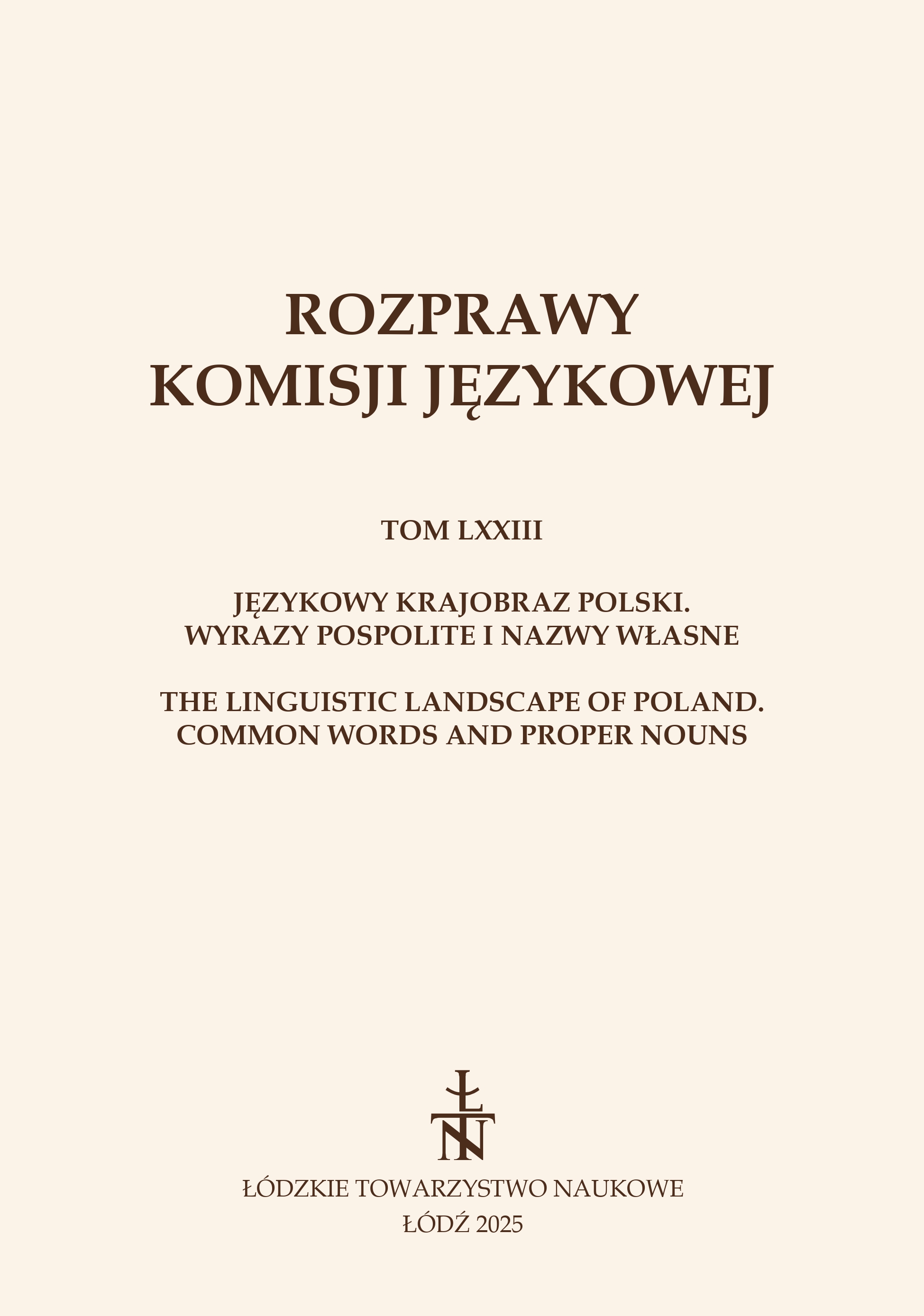
Vol. 73 (2025): THE LINGUISTIC LANDSCAPE OF POLAND. COMMON WORDS AND PROPER NOUNS

					View Vol. 73 (2025): THE LINGUISTIC LANDSCAPE OF POLAND. COMMON WORDS AND PROPER NOUNS
VOLUME EDITORS: Irena Jaros, Halina Kurek, Stanisław Cygan

Co-financed by the Minister of Culture and National Heritage from the Promotion of Culture Fund

mceclip8-303010015ba913aa6099bd88af6c6387.png

Published: 2025-12-02

EDITORIAL

  • Od Redakcji

    13-14
    DOI: https://doi.org/10.26485/RKJ/2025/73/0

ARTICLES

  • From Szczebrzeszyn to the Department of Marie Curie-Skłodowska University in Lublin. A Sketch for a Portrait of Professor Halina Pelcowa

    Stanisław Cygan
    15-49
    DOI: https://doi.org/10.26485/RKJ/2025/73/1
  • Polish-East Slavic Borderland as Exemplified by Włodawa Anthroponymy

    Feliks Czyżewski
    51-73
    DOI: https://doi.org/10.26485/RKJ/2025/73/2
  • From the History of Dialectology. An Unknown Page of the Sejny Dialect’s Past

    Stanisław Dubisz
    75-86
    DOI: https://doi.org/10.26485/RKJ/2025/73/3
  • Polish-Ukrainian Lexical Relations in the Light of Research by Professor Halina Pelcowa

    Agnieszka Dudek-Szumigaj, Marek Olejnik
    87-97
    DOI: https://doi.org/10.26485/RKJ/2025/73/4
  • The Word Formation of Dialectal Resultative Nouns

    Beata Gala-Milczarek
    99-108
    DOI: https://doi.org/10.26485/RKJ/2025/73/5
  • Vocabulary Associated with Ceremonies of the Church Year in Halina Pelcowa’s "Dialect Dictionary of the Lublin Region"

    Barbara Grabka
    109-119
    DOI: https://doi.org/10.26485/RKJ/2025/73/6
  • "Słownik gwar Lubelszczyzny" ("A Dialect Dictionary of the Lublin Region") by Professor Halina Pelcowa as a Source of Knowledge and Inspiration in Regional Education

    Ilona Gumowska-Grochot
    121-131
    DOI: https://doi.org/10.26485/RKJ/2025/73/7
  • On the Geographical Exposition of Polish Synonymous Adjectival Derivatives

    Irena Jaros
    133-144
    DOI: https://doi.org/10.26485/RKJ/2025/73/8
  • Functions of the Wives’ Names in a Traditional Rural Society (on the Example of Truskolasy Next to Częstochowa)

    Tomasz Jelonek
    145-156
    DOI: https://doi.org/10.26485/RKJ/2025/73/9
  • More About the Dialect Words "Zajda", "Zajdy", "Zajdki", Their Variants and Derivates

    Halina Karaś
    157-171
    DOI: https://doi.org/10.26485/RKJ/2025/73/10
  • History of the Polish Spiš Recorded in the Dialect Dictionary (from the Works on the an "Illustrated Dictionary of the Spiš Dialect and Culture")

    Józef Kąś, Maciej Rak
    173-186
    DOI: https://doi.org/10.26485/RKJ/2025/73/11
  • Lexis of the Thematic Microfield "STORM" in the Language of the Inhabitants of Greater Poland (Part 1)

    Justyna Kobus
    187-198
    DOI: https://doi.org/10.26485/RKJ/2025/73/12
  • Krajna and Lublin Region – Lexical Parallels (on the Basis of Culinary Terms)

    Krzysztof Kołatka
    199-214
    DOI: https://doi.org/10.26485/RKJ/2025/73/13
  • "Kałmuk' in Polish dialects

    Katarzyna Konczewska
    215-227
    DOI: https://doi.org/10.26485/RKJ/2025/73/14
  • Lexemes "Brejdak", "Brejdaczka" in Various Varieties of Polish Language

    Renata Kucharzyk
    229-241
    DOI: https://doi.org/10.26485/RKJ/2025/73/15
  • "Totyz" – the Mysterious Name of a Lady’s Thumb Plant ("Polygonum Persicaria" L.) Used in the Dialect of the Podhale Region

    Ilona Kulak
    243-252
    DOI: https://doi.org/10.26485/RKJ/2025/73/16
  • Peasant’s Field as a Value

    Halina Kurek
    253-264
    DOI: https://doi.org/10.26485/RKJ/2025/73/17
  • Halina Irena Pelc (Pelcowa) from the House of Bartnik – in the Circle of the Name and Surname of the Jubilarian

    Renata Marciniak-Firadza
    265-281
    DOI: https://doi.org/10.26485/RKJ/2025/73/18
  • The One Who Knows, Speaks, and Acts: The Linguistic Image of Healing Preserved in Folk Healers’ Names

    Marzena Marczewska
    283-300
    DOI: https://doi.org/10.26485/RKJ/2025/73/19
  • "A White World, a Yellow Flower in It…" Polish Folk Worldview: Distortion or Transparency?

    Stanisława Niebrzegowska-Bartmińska
    301-319
    DOI: https://doi.org/10.26485/RKJ/2025/73/20
  • Culinary Customs from Fat Thursday to Holy Saturday in the Language and Culture of the Inhabitants of Konin and the Surrounding Area

    Błażej Osowski
    321-332
    DOI: https://doi.org/10.26485/RKJ/2025/73/21
  • Some Remarks on My Native Lasowiak Dialects

    Kazimierz Ożóg
    333-343
    DOI: https://doi.org/10.26485/RKJ/2025/73/22
  • Dialectal Expressive Lexis Referring to a Person – Analysis of Selected Examples from Southern Lesser Poland from a Receiver’s Perspective

    Anna Piechnik
    345-360
    DOI: https://doi.org/10.26485/RKJ/2025/73/23
  • On Several Neoregionalisms Related to Urban Transport in Poznań

    Anna Piotrowicz-Krenc, Małgorzata Witaszek-Samborska
    361-368
    DOI: https://doi.org/10.26485/RKJ/2025/73/24
  • "Na wszystko jest przysłowie". The Formation of the Semantics of the Lexeme "Przysłowie" ‘Proverb’ in the Standard and Dialectal Polish Language

    Emil Popławski
    369-379
    DOI: https://doi.org/10.26485/RKJ/2025/73/25
  • Language in Relation to Socio-Cultural Identity and Literary Verism. On the Silesian Edition of Gerhart Hauptmann’s "the Weavers" ("Tkŏcze")

    Artur Rejter
    381-391
    DOI: https://doi.org/10.26485/RKJ/2025/73/26
  • The Warmia Dialect of the Village of Bredynki in Historical Dialectology

    Dorota Krystyna Rembiszewska, Janusz Siatkowski
    393-402
    DOI: https://doi.org/10.26485/RKJ/2025/73/27
  • East Slavic Elements in Adam Mickiewicz’s "Dziady"

    Elżbieta Rudnicka-Fira
    403-418
    DOI: https://doi.org/10.26485/RKJ/2025/73/28
  • The Usefulness of Karol Dejna’s "Folk Vocabulary…" for Research on the Lexis in the Field of Construction

    Katarzyna Sicińska
    419-435
    DOI: https://doi.org/10.26485/RKJ/2025/73/29
  • From Contemporary Greater Poland Dialects: Ambivalence of the Type "Pozywać // Nazywać"

    Jerzy Sierociuk
    437-449
    DOI: https://doi.org/10.26485/RKJ/2025/73/30
  • To Have an Excellent Knowledge of Dialectology, to Know It Very Well – Like a Specialist

    Kazimierz Sikora
    451-464
    DOI: https://doi.org/10.26485/RKJ/2025/73/31
  • Vocabulary Associated with the Organisation and Life of Villages in "Obrazki stanu włościan litewskich do ich usamowolnienia to jest do roku 1864" by Adam Bućkiewicz

    Urszula Sokólska
    465-479
    DOI: https://doi.org/10.26485/RKJ/2025/73/32
  • On the Bulgarian-Polish Asymmetry in the Development of the Vocabulary of Proto-Slavic Origin (Based on the Example of Selected Bulgarian Dialectal Words and Their Equivalents in Polish)

    Petar Sotirov
    481-490
    DOI: https://doi.org/10.26485/RKJ/2025/73/33
  • "A Tree So Unhappy…" About the Idea of Categorization in Folk Culture as Exemplified by Aspen

    Joanna Szadura
    491-504
    DOI: https://doi.org/10.26485/RKJ/2025/73/34
  • Profiling the Kuyavian-Pomeranian Region in Tourist Guide "Bydgoszcz i okolice" (Based on the Example of Aesthetization and Aesthetic Profiles)

    Małgorzata Święcicka, Monika Peplińska
    505-517
    DOI: https://doi.org/10.26485/RKJ/2025/73/35
  • Youth and Oldness According to Village Residents

    Anna Tyrpa
    519-535
    DOI: https://doi.org/10.26485/RKJ/2025/73/36
  • The Etymology of Polish Dialectal Plant Names Is Full of Mysteries

    Jadwiga Waniakowa
    537-548
    DOI: https://doi.org/10.26485/RKJ/2025/73/37
  • In Search of Markers of the Elegance in Language

    Elżbieta Wierzbicka-Piotrowska
    549-562
    DOI: https://doi.org/10.26485/RKJ/2025/73/38
  • A Sketch on the Stylistics of the Genre

    Maria Wojtak
    563-574
    DOI: https://doi.org/10.26485/RKJ/2025/73/39
  • Untrue, False News. Rumours, Gossip, Gossiping, Gossipers (on the Dialect Material)

    Włodzimierz Wysoczański
    575-600
    DOI: https://doi.org/10.26485/RKJ/2025/73/40